Understanding Plug Compatibility: Why Standardization Matters for Hybrid TRUs

As more fleets adopt electric standby for refrigerated trailers, one of the most important (and most overlooked) considerations is plug compatibility. The type of inlet on a TRU determines what it can safely plug into, what power it can accept, and whether it will work reliably across a mixed fleet.

Confusion often arises because containers, trailers, and box trucks all use different connection configurations, and not all connectors are interchangeable. Standardization is what keeps operations safe, efficient, and compliant, especially as electrification accelerates across the cold chain.

This guide breaks down the differences, what standardization actually means, and how operators can avoid costly compatibility issues.

Why Plug Compatibility Matters for eTRUs

Electric transport refrigeration units (eTRUs) rely on a dedicated power inlet that must match the electrical configuration of the equipment providing shore power.  When an unstandardized or unrecognized connection type is used, facilities can risk:

  • Unsafe electrical connections
  • Incorrect grounding or phase alignment
  • Equipment that cannot be powered
  • Higher installation and maintenance costs, specially with expensive proprietary equipment
  • Increased downtime

Standardization ensures that eTRUs across different makes and models can be powered safely and consistently.

Why Different Refrigerated Equipment Uses Different Plugs

This occurs when a trailer first connects to shore power and must pull the temperature of the trailer down to the required temp.
Although refrigerated containers, box trucks, and trailer TRUs all rely on electric power, they do not use the same connector. Each type of equipment is designed with its own electrical configuration, ensuring it can only be connected to the appropriate power source.

This matters because it prevents equipment from being plugged into a circuit with the wrong voltage, amp, or configuration.

Refrigerated Containers

Containers use IEC 60309 connectors, but with different ratings and configurations than trailer TRUs. Even if they look similar, they are not compatible, which prevents incorrect use.

Box Trucks

Many box trucks operate on 50A, 240V systems. These require their own dedicated infrastructure or a specialized unit that can deliver both 480V and 240V, but typically cannot connect to the receptacles used for trailer electric standby.

These differences are intentional. They help keep equipment protected and ensure that only properly matched systems are connected.

Avoiding Proprietary Plug Systems

OncWhile standardized IEC connectors support consistent, cross-fleet compatibility, some systems use proprietary multi-pin connectors, including 6-pin variations. These require specialized parts, limit compatibility, and increase long-term cost compared to standardized configurations.

Choosing non-proprietary connectors keeps operations flexible and supports mixed fleets without tying facilities to a single supplier or hardware ecosystem.

Want a deeper technical look at plug types,
OEM compatibility, and electrification planning?

Explore our eTRU Webinar Series

How ESL Supports Standardized, Non-Proprietary Operation

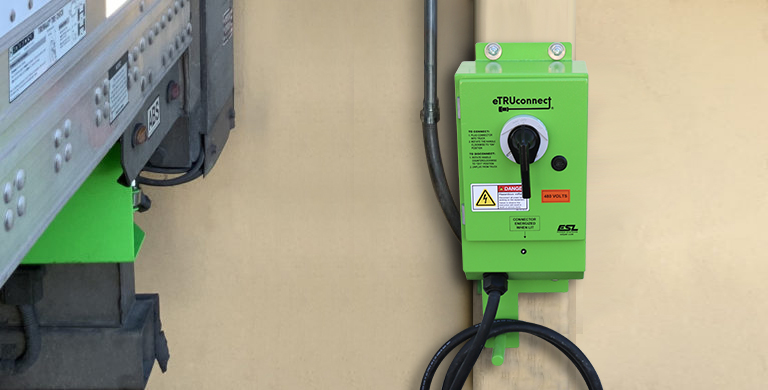
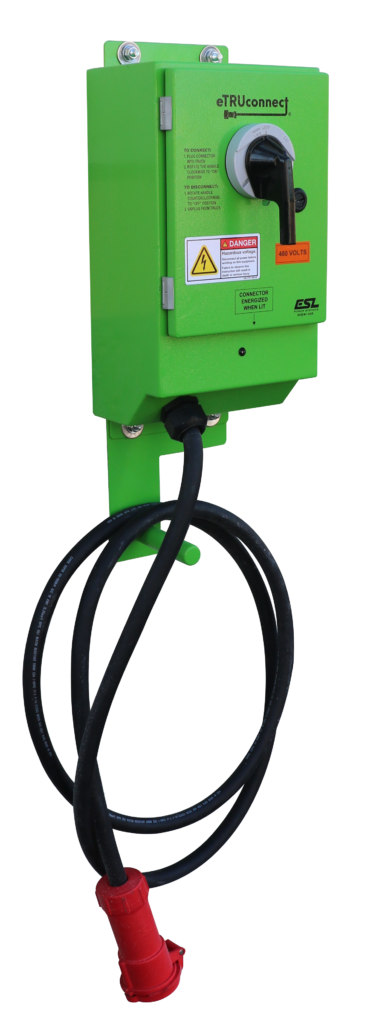
ESL’s eTRUconnect® system is built around the standard IEC 60309 trailer connector, ensuring compatibility with electric-standby-equipped TRUs across major OEMs.

Key advantages include:

  • Universal TRU compatibility using standardized IEC connectors
  • Safety-interlocked design that cuts power during disconnect
  • Integrated branch-circuit protection for safe operation
  • Durable, outdoor-rated construction for harsh yard environments
  • Dual drive-off protection to prevent equipment damage

This standardized, non-proprietary approach ensures facilities can electrify confidently and support mixed fleets without costly customization.

Planning eTRU Shore Power Infrastructure With Compatibility in Mind

Not every trailer operates at peak load simultaneously. Most facilities see a predictable mix:

Choosing standardized IEC trailer connectors provides clear benefits when expanding or upgrading electric standby infrastructure:

  1. Cross-Fleet Flexibility
    Any trailer with a standard IEC inlet can connect to any compatible position.
  2. Operational Simplicity
    A single connector type reduces training needs and minimizes operator errors.
  3. Lower Total Cost of Ownership
    Standard parts minimize long-term maintenance and replacement costs.
  4. Future-Ready Design
    As fleets evolve, standardized connectors ensure new equipment remains compatible.

Why Standardization Is the Smartest Path Forward

Standardizing around IEC 60309 connectors provides a safe, scalable foundation for electric TRU adoption. Using a widely supported, non-proprietary connection system gives facilities the flexibility to support mixed fleets, adapt as equipment evolves, and protect their infrastructure investment.

Whether electrifying a few positions or an entire yard, standardization keeps operations reliable and future-ready.

Ready to Simplify Electrification for Your Fleet?

Let’s talk through your goals and determine what infrastructure approach makes the most sense for your facility.

eTRU Power Requirements Explained: How Much Energy Does an Electric Reefer Use?

Electrifying refrigerated trailers is one of the most effective ways facilities can reduce diesel consumption, cut emissions, reduce maintenance, and meet ongoing compliance requirements. Before investing in electrification, facilities need to understand how much power an eTRU uses, what it means for operating costs, and how those requirements impact ROI.

This article breaks down real-world eTRU power needs, what facilities should expect across common operating conditions, and how to plan electrical capacity that supports both today’s fleets and the next generation of refrigerated trailers.

How Much Power Does an eTRU Use?

Electric TRUs draw different amounts of power depending on whether they’re actively cooling down a trailer or maintaining its temperature. These modes directly influence how yards, warehouses, and distribution centers plan electrical capacity.

Pulling Down Temperature (Heavy Load)

This occurs when a trailer first connects to shore power and must pull the temperature of the trailer down to the required temp.

Typical power demand:

  • 15 to 17 kW
  • Duration: 45 to 60 minutes per cycle

This is the peak load a facility should account for when designing electrical capacity.

 Maintaining Temperature (Light Load)

Once a trailer reaches its target temperature, it enters a steady operating mode that represents the majority of TRU runtime.

Typical power demand:

  • 8 to 12 kW
  • Represents 80 to 90 percent of operating hours

This range is the most important for planning continuous load availability.

How eTRU Power Use Compares to Diesel TRUs

Understanding energy demand is only part of the equation. Many facilities also want to know how electric standby compares directly to diesel operation.

Here’s what changes when a TRU runs on electricity instead of diesel:

✔ No fuel burn during idle

A diesel TRU typically consumes close to a gallon of fuel per hour while maintaining temperature. Electric standby removes that consumption entirely.

✔ Lower operating cost per hour

Electricity is consistently less expensive than diesel across most commercial markets, leading to significantly lower hourly operating costs.

✔ Less engine wear

Reduced idling helps extend engine life and cut maintenance costs by reducing run hours.

✔ Cleaner and quieter operation

Electric standby eliminates diesel exhaust and reduces noise, improving working conditions and community impact.

See How Much Your Facility Can Save With Electric Standby

Run the numbers for your operation and compare diesel costs to electric power.

Why These Power Levels Matter for Infrastructure Planning

Not every trailer operates at peak load simultaneously. Most facilities see a predictable mix:

  • A few trailers in temperature pull-down
  • The majority maintaining temperature
  • Several unplugged, staging, or moving

Understanding this natural diversity helps avoid oversizing or undersizing electrical systems and ensures consistent power availability without unnecessary cost.

Circuit and Power Requirements for eTRUconnect

Electric standby systems rely on clean, consistent power delivery, and that’s exactly what eTRUconnect is designed to support. The system integrates the key electrical requirements needed for reliable TRU operation, including:

  • 480VAC service to provide power to TRU’s
  • 30 A branch circuits sized specifically for electric standby
  • Built-in branch circuit protection for safe, compliant operation
  • Safety-interlocked connectors that automatically cut power during disconnect

These design elements help ensure safe operation, protect equipment, and provide the dependable power TRUs need during both pull-down and temperature maintenance.

How to Estimate Your Yard’s Power Needs

Facilities can get a clear picture of required electrical capacity with a simple three-step approach:

  1. Count Your Connection Points
    Include docks, yard positions, and any planned expansion areas.

  2. Estimate How Trailers Typically Operate
    Most sites have a mix:  some pull-down, some maintain temperature, and some are unplugged or staging. Determine your general mix.

  3. Apply the Expected Power Ranges
    • Pull-down: 15–17 kW
    • Maintain: 8–12 kW

This gives a realistic view of both peak demand and everyday continuous load. Leaving extra capacity helps accommodate fleet growth and future electric TRU technology.

Future Proofing: Planning for What Comes Next

Today’s electric standby TRUs operate within predictable power ranges, but the next generation of battery-electric TRUs will require more capacity, new connector types, and smarter power management. Preparing for these shifts now can help facilities avoid costly retrofits later.

Looking ahead, operations should expect:

  • Higher AC power needs
  • More diverse charging and connector standards
  • Increased demand for monitoring and load management
  • Greater emphasis on scalable infrastructure

Building electrical systems with future capacity in mind allows facilities to transition smoothly as technology evolves, regulations tighten, and more electric-powered equipment enters the market. Electrification is accelerating across the cold chain, and yards that plan ahead will be positioned to support both today’s eTRUs and the fully electric fleets of tomorrow.

Ready to Plan Electrification for Your Facility?

Our team can help you evaluate power needs, infrastructure requirements, and long term growth planning.

What Is eTRU and How Does It Support Cleaner Cold Chain Operations?

Refrigerated transport is one of the most critical links in today’s supply chain, but it’s also among the most energy-intensive. For decades, diesel-powered transport refrigeration units (TRUs) have been the standard for keeping cargo at temperature in trailers and box trucks.

Now, as fuel costs climb and emissions standards tighten, the cold chain industry is shifting toward a cleaner, smarter solution: electric transport refrigeration units, known simply as eTRUs.

What Is an eTRU?

An electric transport refrigeration unit (eTRU) allows a refrigerated trailer or truck to maintain temperature by plugging into the local electrical grid instead of running its diesel engine.

When connected to a truck shore power system such as ESL Power Systems’ eTRUconnect®, the TRU draws roughly 20kWof electricity, enough to power its cooling system efficiently while idle at a warehouse, terminal, or cold storage yard.

In short: eTRUs replace fuel burn with electricity, reducing emissions, operating costs, and maintenance, without compromising performance.oom for error. If a shore power connection fails, ships can’t run as planned and valuable cargo could be delayed or put at risk.

Why Electric Standby Matters for Fleets and Facilities

Every hour a diesel TRU idles, it burns close to a gallon of fuel and adds hours of engine wear. Switching to electric standby changes that equation:

  • 50–65% lower running costs compared to diesel
  • 20–30% longer engine life from reduced idle time
  • ROI in 12–18 months 

For distribution centers managing multiple trailers, these efficiencies translate into thousands in annual savings, and a faster path to sustainability compliance.

Check out our eTRU Webinar Series for a deeper look at fleet electrification, compliance planning, and real-world implementation strategies. 

Reducing Emissions and Meeting Compliance Goals

Electrifying TRUs has quickly become a key part of how fleets meet evolving emissions rules.
Agencies such as the California Air Resources Board (CARB) and local air districts (AQMD) are mandating cleaner operations across the supply chain.

Running TRUs on electricity instead of diesel helps facilities align with:

  • CARB’s Zero-Emission TRU Rule:  requiring new zero-emission TRUs by 2031–2035
  • AQMD Rule 2305:  reducing emissions from warehouses over 100,000 sq. ft.
  • Corporate sustainability initiatives linked to greenhouse-gas reduction targets

And there’s a community benefit too: electric standby eliminates noise pollution, improving air quality and working conditions for nearby residents and employees alike.

Sustainability That Pays Back

Electric standby systems aren’t just cleaner and cost efficient, they can generate revenue.

Through the Low Carbon Fuel Standard (LCFS), fleets that replace diesel with electricity earn credits for every kilowatt-hour used, typically worth $0.07–$0.10 per kWh. These credits can be reinvested into additional electrification projects or used to offset operating costs.

Across the U.S. and Canada, utilities also support truck shore power adoption with:

Regional incentives in states like California, Missouri, Texas, and Oregon

Infrastructure rebates covering design and installation

Up to 50% cost coverage on qualified equipment

Safety and Engineering Built for Real-World Use

Cold chain yards are tough environments exposed to weather, heavy traffic, and constant use. That’s why ESL’s eTRUconnect® is engineered for safety, compliance, and durability in the field:

  • UL/cUL Listed and NEC-compliant construction
  • Safety-interlocked connectors that disable power during disconnect
  • Dual drive-off protection that cuts power automatically if a trailer  pulls away.
  • Corrosion-resistant, NEMA 3R enclosures built for harsh conditions

These features protect both operators and equipment, helping facilities prevent downtime, avoid repairs, and maintain continuous operation.

For a deeper look at how eTRU systems operate and what to consider during implementation, check out our guide What You Need to Know About eTRU.

Future-Proofing the Cold Chain

Electrification doesn’t stop with hybrid TRUs. Battery-electric TRUs are the next step, and the infrastructure you install today lays the groundwork for that transition.

Facilities equipped with 240 V or 480 V eTRU systems already have the right platform for tomorrow’s charging systems. By planning ahead, operators can avoid costly retrofits while staying ahead of:

  • Stricter CARB emission mandates
  • Utility capacity upgrades
  • Customer and ESG reporting requirements
  • Future Products and technology that will require additional infrastructure

Forward-thinking facilities that electrify now will be best positioned to meet future standards, and win contracts with sustainability-focused shippers.

Did you know?

A regular eTRU can save about one gallon of diesel every hour when operating on electric standby. That translates to major cost and emissions savings, preventing roughly 20 pounds of CO₂ emissions for every gallon of diesel avoided, with facilities often seeing ROI in about a year.

Powering a Smarter, Cleaner Supply Chain

Adopting eTRU systems is one of the most practical ways fleets can cut emissions, control costs, and meet new regulations, all without disrupting operations.

With over 30 years of electrical engineering experience and more than 300,000 connection points deployed, ESL Power Systems provides proven, safety-certified solutions that help fleets electrify with confidence.

Ready to See What Electrification Could Mean for Your Facility?

Connect with our team to discuss power requirements, infrastructure options, and available incentives.

California Transport Refrigeration Unit Regulations in Development

Pending TRU California Regulation

Pending TRU regulations will require that diesel engines be phased out over the next six years in an effort to help improve the environmental impact of the trucking industry. Facility and fleet operators should consider options to reduce emissions at their facilities.

Truck Refrigeration Units, commonly referred to as TRUs, are refrigeration systems that are typically powered by internal combustion engines. TRUs control the environment of temperature-sensitive products that are transported in refrigerated trucks, trailers, railcars and shipping containers. TRUs are used to transport and store many products such as food, pharmaceuticals, plants, medicines, and chemicals.

Some companies use TRUs for extended cold storage. Distribution centers and grocery stores may run out of cold storage space in their buildings and then opt to store overflow goods in TRU-equipped trucks and trailers outside their buildings. Distribution centers, truck stops and other cold storage facilities also attract large volumes of TRUs that contribute to higher localized health risks. New regulations are developing concepts to reduce emissions from facilities with TRU activity by transitioning to zero-emission operation where practical.

According to SCE.com, Southern California Edison is aiding in these pending regulations by offering a program designed to help qualifying SCE commercial customers install the charging/powering infrastructure needed to electrify medium- and heavy-duty fleets. SCE’s Charge Ready Transport Program is providing a funding initiative for installation of infrastructure to SCE commercial customers. Through this program, SCE’s goal is to advance the vision for a clean energy future while providing medium- and heavy-duty fleet owners the opportunity to save money. The program is offering opportunities such as, no-cost installation of electric infrastructure or giving businesses the option to install, own, operate and maintain the infrastructure on site for a rebate at 80% of cost. SCE is also offering special incentives such as commercial rate options that make EV charging and TRU shore power more affordable during certain times of the day.

In addition to SCE’s infrastructure programs, CARBs Clean Off-Road Equipment Voucher Incentive Project (CORE) offers a streamlined voucher process for buyers to receive funding to offset the adoption costs of clean, commercial ready zero-emission equipment including transport refrigeration units, cargo-handling equipment, and more. CARB also offers eligibility opportunities to offset electricity costs through the Low Carbon Fuel Standard (LCFS) Program which is designed to encourage the use of cleaner low-carbon fuels in California, encourage the production of those fuels, and therefore, reduce greenhouse gas emissions.

Charge Ready Transport, LCFS and CORE are some of the many incentives available in California that provide opportunities to reduce your organization’s carbon footprint and improve the air quality of your community all while cutting operation and maintenance costs to your fleet.

Get ahead of the competition; learn more about SCE’s Charge Ready Transport and reducing greenhouse gas emissions here: https://www.sce.com/business/electric-cars/charge-ready-transport.

If you’re interested in learning how ESL can help provide safe utility power to electric or hybrid TRUs check out our eTRUconnect:  https://eslpwr.com/etruconnect/

ESL Launches eTRUconnect V2 with a Commitment to Continuous Improvement

ESL Launches eTRUconnect V2 with a Commitment to Continuous Improvement

CORONA, California, November 2, 2021 – ESL is pleased to announce the release of the eTRUconnect® V2 PS series now with a smaller footprint, easier access and simplified operation.

ESL’s UL Listed eTRUconnect® V2 PS Series provides safe utility shore power to electric or hybrid refrigerated units on truck trailers. Connecting electric or hybrid refrigerated units to shore power eliminates the need of running onboard diesel generators/engines to keep the cargo within the optimal temperature range thus eliminating emissions while loading/unloading or idle. This system results in significant savings attributed to much lower electric energy cost. eTRUconnect’s, safe and simple connection and disconnection procedure allows truck operators to use the system while minimizing the risk of injury and the liability to the facility owner.

eTRUconnect V2

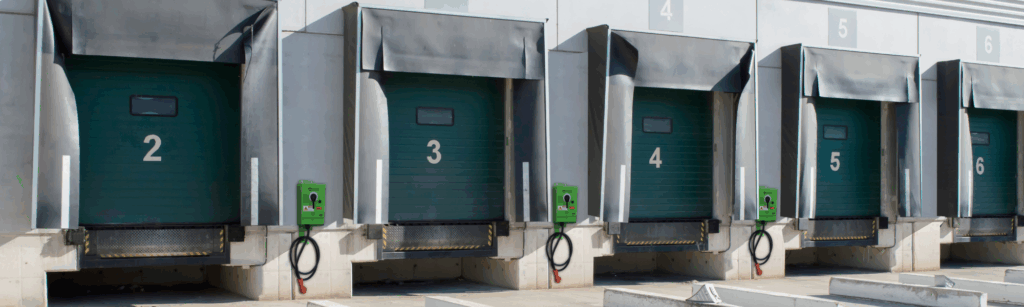
In an effort to continuously improve ESL’s eTRUconnect, the V2 has been redesigned to fit into tight spaces between dock doors. For staging yard installations, the eTRUconnect V2 can easily be mounted on a pole or rack with the optional mounting kit.

Powering on the eTRUconnect is now simplified with the new V2 “actuation” handle. Just like with the original eTRUconnect, ESL’s solution cannot be energized until the 4-pin female plug and the truck-trailer inlet are completely mated.

A new optional LED beacon light and the option to integrate with dock door signaling or wheel restraining systems have also been upgraded additions to the eTRUconnect V2.

Like the original eTRUconnect design, the V2 relies on a safety-circuit loop to ensure safe connection and energization. Our innovative design does not require 2 extra pilot pins at the connector. A connection detection device is embedded in the safety-interlocked IEC female plug installed at the end of the cable.

All original safety features are included in the V2 including unintended drive-off and electrical branch circuit protection. In the case of a drive-away, the eTRUconnect V2 PS Series has connections within the enclosure that easily pull apart, shutting power off within milliseconds, minimizing equipment damage and eliminating the risk of injury. For electrical protection, ESL’s eTRUconnect V2 contains a 3-pole molded case circuit breaker (available at multiple AIC ratings) that protects against overloads and short circuits. In addition, the eTRUconnect V2 now offers ease of access through the front of the enclosure with a simplified turn key system.

Utilizing the eTRUconnect® V2 provides substantial improvement in efficiencies and meets all SmartWay™ requirements, helping to improve the environmental impact of the trucking industry. For additional information and downloadable specification sheets visit etruconnect.com.