How to Choose a Company Switch: 8 Specs to Confirm Before You Buy

How to Choose a Company Switch: 8 Specs to Confirm Before You Buy

A company switch is the connection point where portable cam-lock cable feeds tie into a venue’s electrical system to power temporary equipment like touring sound, lighting, and broadcast gear. ESL Power Systems builds this equipment as the ShowSwitch™ line — 100A, 200A, and 400A standard cam-lock configurations, 60–100A pin & sleeve theatre outlets, and custom concert power distribution boards up to 1600A, all UL 891 Listed as theatrical switchboards. Choosing the wrong configuration usually shows up on load-in day, not before. The eight specs below apply to any company switch on the market; we’ve noted how the ShowSwitch line is built for each one.

Quick answer Before you specify or purchase a company switch, confirm: incoming wire size, 200% rated neutral, isolated ground, direct-wire lugs, digital ammeter, interior work light (standard on ShowSwitch), NEMA 1 vs. NEMA 3R/3RX enclosure, and mechanical vs. electrical interlock.

Jump to a spec:

What incoming wire size does a company switch need?

Short answer: Match the lugs to the conductor size, count, and material of the feed actually arriving at the install — not a spec sheet from a different job.

Undersized lugs can’t accept the conductors; oversized lugs leave a loose termination. Before ordering, confirm:

  1. Conductor size and count of the incoming feed
  2. Where conduit enters the enclosure (top, bottom, or side)
  3. Whether the feed is aluminum or copper — lug ratings differ

ESL’s ShowSwitch line sizes line terminals by amperage rather than using one lug kit across the board, so confirming the amperage and conductor size against the table below before ordering avoids a mismatched lug kit at load-in:

ModelAmperageLine TerminalsNeutralGround
3313-01100A#14 AWG – 3/0#6 AWG – 250 kcmil#6 AWG – 250 kcmil
3323-01200A3/0 – 350 kcmil#6 AWG – 250 kcmil#6 AWG – 250 kcmil
3343-01400A(2) 2/0 – 500 kcmil(2) #2 – 600 kcmil#6 AWG – 250 kcmil

Do you need a 200% rated neutral?

Short answer: Yes, if the load includes dimming systems, switch-mode power supplies, LED lighting, or other equipment that generates harmonic currents — standard neutrals sized to match the phase conductors aren’t enough for loads like these.

Neutral loading should be evaluated during system design. Keep in mind that triplen harmonics [180Hz] stack directly on top of each other at the neutral node.

Note: adding a second neutral can mean six cam-lock receptacles instead of five, so this affects the panel’s physical layout, not just its wiring. On the 400A ShowSwitch (3343-01), this is built in as dual #2–600 kcmil neutral terminals rather than a single lug — flag the load profile at time of order so the correct neutral configuration ships from the factory.

Is isolated ground required?

Short answer: Yes, any time the downstream load includes audio equipment sensitive to ground-loop hum or buzz.

An isolated grounding conductor provides a dedicated grounding path for sensitive electronic equipment, helping reduce electrical noise and ground-loop issues in audio systems.

ESL offers isolated ground as a factory option on ShowSwitch: an isolated ground bus, separated from the equipment ground bonded to the enclosure, can be specified at time of order for systems feeding sensitive audio gear. Flag this requirement up front — it changes the internal bussing rather than being a field modification.

Do you need direct-wire lugs?

Short answer: Yes, if any downstream equipment doesn’t have cam-lock connectors — direct-wire lugs let bare conductor ends terminate directly, no cam adapter needed.

Company switches are built around cam-lock connectors, but not every piece of connected equipment has them. Confirm this capability if any downstream gear lacks cam connectors.

On ShowSwitch, the direct-wire lug option uses mechanical lugs rated for #6 AWG to 250 MCM — useful for older house dimmer racks or fixed distro that predates cam-lock standardization. ESL also offers reverse-gender neutral and ground configurations and a POSI-LOK™ panel option for cam terminations where a different connection style is needed.

Do you need a digital ammeter?

Short answer: Yes, if you need a real-time read of current draw — to verify loads against rated capacity or track demand changes throughout an event.

A built-in digital ammeter provides a convenient way to monitor current draw in real time, helping venue managers identify potential overload conditions before protective devices trip. Without a built-in meter, operators may need to rely on external test equipment or system calculations to monitor loading.

ShowSwitch offers a UL Listed 1/4 DIN volt-amp meter with a three-row, three-digit LED display, accurate to ±0.5% of full scale on voltage and ±2 digits on current, reading all three phases simultaneously by default. Every unit also carries door-mounted indicator lights that illuminate when each cam connector is mated and the breaker is on — a quick visual check before anyone touches a live connection.

Do you need an interior work light?

Short answer: Yes — it’s a low-cost option with an outsized effect on install speed and safety, since company switches are frequently accessed in dark venue environments: backstage, in trussing, under a stage.

An interior work light now ships as standard equipment on ShowSwitch, so this is one less option to track down separately — the chamber is lit as soon as the door opens, with no need to call it out as an add-on when specifying your unit.

Indoor or outdoor: NEMA 1, 3R, or 3RX enclosure?

Short answer: NEMA 1 for standard indoor/dry installs; NEMA 3R or 3RX if the unit will sit outside or in an exposed or corrosive location — it’s an enclosure-level construction difference, not a field retrofit.

Standard company switches ship NEMA Type 1. If the unit will sit outside or in an exposed location, specify NEMA 3R up front.

ShowSwitch’s standard NEMA Type 1 enclosure is 14-gauge steel with a powder-coated matte black finish. Full construction details are on the company switch specifications page. For outdoor work, ESL also offers a Type 3R enclosure (available in lighter colors) and a Type 3RX stainless steel enclosure for coastal air, washdown areas, or other corrosive environments where painted steel would degrade faster.

EnclosureEnvironmentTypical Use
NEMA Type 1Indoor, dry locationsStandard for most venues; ShowSwitch ships Type 1 by default
NEMA Type 3ROutdoor, exposed to rain/weatherFestivals, outdoor stages, exposed perimeters
NEMA Type 3RX (stainless)Outdoor, coastal/washdown, corrosive airLong-term outdoor installs where painted steel would corrode

Mechanical or electrical interlock?

Short answer: Most applications call for at least a mechanical interlock — it requires the intended sequence of operation without relying on a control circuit, so it still works during a control power failure. Add an electrical interlock only if the application needs the extra automation.

Interlocks help prevent unsafe operation by requiring equipment to be operated in the intended sequence. Depending on the application, interlocks may be mechanical, electrical, or a combination of both.

  • Mechanical interlock: Uses physical mechanisms to prevent certain actions or switch positions until specific conditions are met. Because it does not rely on a control circuit, it continues to function even during a control power failure.
  • Electrical interlock: Uses auxiliary contacts, relays, sensors, or control circuits to prevent unintended operation. Electrical interlocks can provide additional functionality and automation but depend on the proper operation of the associated control system.

ESL’s ShowSwitch ships with a mechanical, safety-interlocked door as standard. The interlock prevents making or breaking cam-lock connections under load by requiring the breaker to be opened before the door can be accessed. The operator handle is recessed so it does not protrude into narrow passageways, and the door can be padlocked for additional jobsite security. For applications requiring electrical interlocks or additional control functionality, consult ESL’s engineering team during the specification process.

FAQ: Company Switch Specification

What is a company switch used for? Connecting portable cam-lock power feeds from a venue’s electrical system to temporary equipment such as touring audio, lighting, and video gear.

Is a company switch the same as a transfer switch? No. A transfer switch selects between two power sources (such as utility and generator). A company switch distributes portable feeder cable to temporary equipment.

What amperage does ESL’s ShowSwitch line cover? 100A, 200A, and 400A in standard cam-lock configurations (models 3313-01, 3323-01, and 3343-01), 60–100A pin & sleeve theatre outlets, and custom concert power distribution boards up to 1600A.

Does ESL’s company switch carry a safety listing? Yes — ShowSwitch is UL Listed and labeled under the UL 891 standard for theatrical switchboards, which is typically required for code compliance and insurance in entertainment venues.

Does ShowSwitch include an interior work light? Yes — an interior work light is now standard equipment across the ShowSwitch line.

Final Takeaway

A company switch looks like a simple box with cam-lock connectors on it. The 8 specs above determine whether it fits the job: the wire coming in, the load going out, the environment it sits in, and how safely it fails.

ESL’s ShowSwitch line is built around these same 8 variables — model selection (3313-01, 3323-01, 3343-01, or a custom distribution board), lug and neutral sizing, grounding (including isolated ground), metering, enclosure rating, and interlock type are all confirmed before the unit leaves ESL’s Corona, CA factory, and an interior work light ships standard. Get these confirmed before you order, not during load-in.

Want to see these options on an actual unit? Watch ESL’s ShowSwitch company switch feature video, review the standard specifications and features pages at eslpwr.com, or contact ESL Power Systems at 1-800-922-4188 or info@eslpwr.com to talk through the right configuration for your venue.

ESL Power Systems Expands Partnership with LaSalle Representatives to Cover Additional States

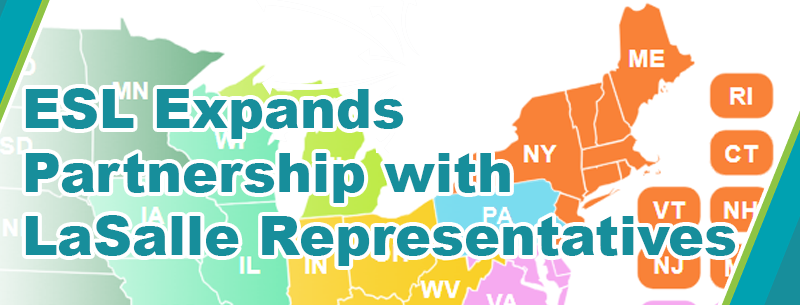
ESL is thrilled to announce a significant expansion in our collaboration with LaSalle Representatives, one of our esteemed manufacturer representatives. LaSalle has been a key player in our network, serving the New Jersey and New York regions with unparalleled dedication. Now, we’re excited to extend their coverage to include Connecticut (CT), Maine (ME), Massachusetts (MA), Rhode Island (RI), Vermont (VT), New Hampshire (NH), and the entirety of New York (NY).

LaSalle Representatives has already proven their commitment to excellence by providing exceptional service in New York Counties, including Bronx, Queens, Manhattan, Kings, Richmond, Suffolk, Nassau, Suffolk, Westchester, Rockland, Putnam, and Orange. Their sales team boasts a rich history in the competitive NYC Metro Market, offering smart, sensible, and cost-effective solutions to our valued customers.

What sets LaSalle apart is their diverse team, comprised of individuals with backgrounds working directly for manufacturers, local distributors, and hands-on field experience. This unique blend enables them to collectively deliver the best service and support for each application, ensuring that our customers receive top-notch assistance.

As ESL Power Systems continues to grow and innovate, we actively seek out the best manufacturer representatives to join us in providing cutting-edge Emergency Power and Entertainment Power Solutions. LaSalle Representatives exemplifies excellence in embracing this opportunity, showcasing a deep understanding and expertise in ESL’s product lines. We take pride in our nationwide network of manufacturer representatives who offer technical expertise and customer service support. To discover the right representative for your state, we invite you to explore our representative map here. At ESL Power Systems, we are dedicated to powering your success and ensuring that you receive the highest level of support for your power solutions needs.

Critical Facilities Technologies: ESL’s Newest MRG

Manufacturing Representative Groups (MRGs) have become an increasingly important resource for businesses looking to enhance their customer service and sales support. At ESL, we recognize the value of MRGs and have made it our mission to find the most experienced and capable partners to help serve our customers across the country.

Our MRGs act as a liaison between our customers and our internal customer experience team, providing an expert level of knowledge and support to address any concerns or issues that may arise. By working with MRGs, we aim to increase customer satisfaction and enhance our sales support capabilities, ultimately improving the overall customer experience.

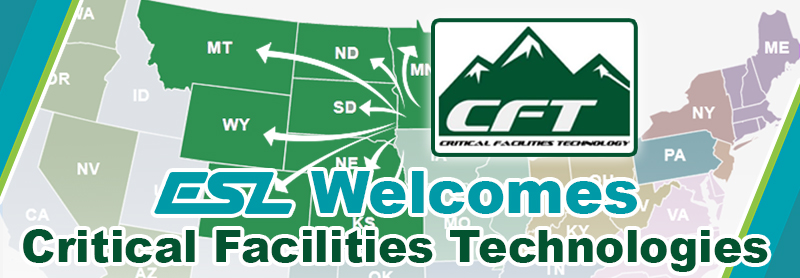
ESL is pleased to announce the latest addition to our expanding ensemble of Manufacturing Representative Groups, Critical Facilities Technologies (CFT). Based in the Midwest, CFT offers a range of services, including design, equipment procurement, project management, and more, to customers in Colorado, Wyoming, Montana, North Dakota, South Dakota, Minnesota, Nebraska, and Kansas. Their team of seasoned professionals possess a wide range of expertise and an impressive wealth of knowledge across diverse industries. This equips them to effectively guide and support projects of any scale, industry, or facility maturity level. Teaming up with CFT empowers ESL to now provide our customers with exceptional levels of support and expertise in these newly covered states. CFT’s extensive regional knowledge is especially valuable when it comes to designing and executing new projects.

ESL proudly provides manufacturer representatives throughout the United States to provide technical and customer service support for our Emergency Power and Entertainment Power Solutions products. To find the right representative for your state, check out or rep map here!

Intro to Company Switches for Temporary Show Power

thumb

Company Switches – Questions to Ask…

When making specifying and purchasing decisions regarding electrical equipment for entertainment venues there are many factors to consider. When challenged with choosing between company switches and standard disconnect switches, the top of the priority list should always be safety. While disconnect switches may often be the more affordable option, the value added into a company switch becomes apparent once all factors are considered.

What is a Company Switch?

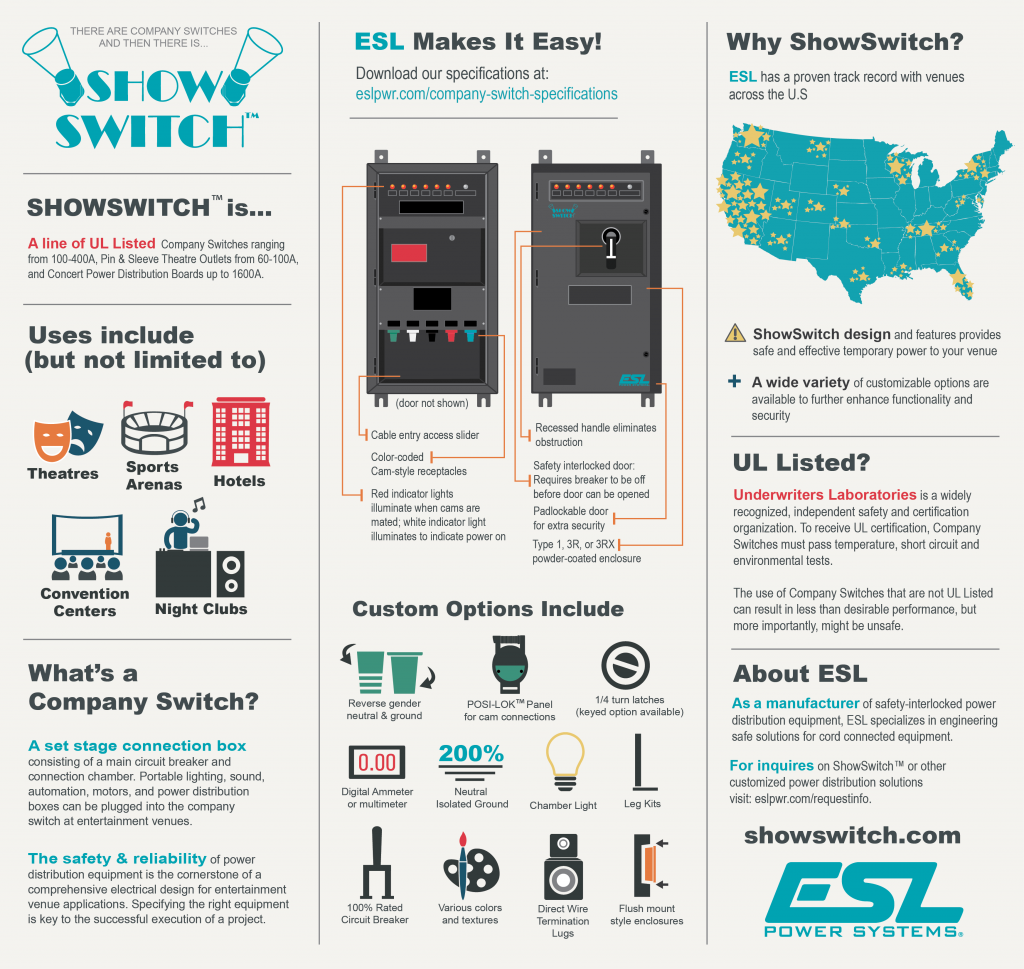
A company switch is a power tap box that portable lighting, sound, automation, motors, and power distribution boxes can be plugged into. Often located backstage or in hidden areas of theaters and arenas, standard company switches are rated 100 – 400 amps. Company switches usually consist of a main circuit breaker and connection chamber; a common configuration is 208/120VAC 3-Phase 5 Wire. Equipment connections in the U.S. are typically made via female cam-style connectors. Color-coding for 208/120 is most often Red-Phase A, Black-Phase B, Blue-Phase C, White-Neutral, Green-Ground. However, additional options and configurations are available per customer requirements.

What Should I Consider When Selecting a Company Switch?

Safety
Safety is the primary concern in any production, especially when dealing with live power. A safety-interlock preventing access to live connections is critical. The door of a company switch should be safety-interlocked to only allow access to the connection chamber. Access to the deadfront-protected circuit breaker compartment should only be permitted after the main circuit breaker is physically turned to the off position. Further safety recommendations include indicator lights that show when power is being fed to the unit and also when upstream power has been cut to the unit, signaling that it is safe to perform maintenance or repairs.

Verifying that the assembly has passed a series of performance and safety tests and is specifically designed for the intended application is critical. Company switches that are third party certified undergo rigorous tests to ensure the safety of the units. Underwriters Laboratories (UL) is a widely recognized, independent safety and certification organization. In order to receive UL certification, company switches must pass temperature, short circuit and environmental tests. The use of Company Switches that are not UL Listed can result in less than desirable performance, but more importantly, might be unsafe.

Security
In order to restrict operation to authorized personnel, Company Switch assemblies should be equipped with a padlockable main access door allowing access to the connection chamber only. It is also beneficial for the interlocked circuit breaker handle to be padlockable so the circuit breaker can be locked in the off position, thereby preventing unauthorized use.

Aesthetics
Since Company Switches are typically installed close to the stage for accessibility, it is important to ensure the unit remains hidden from the concert-goers’ view. Some Company Switch manufacturers provide options such as a wrinkle black finish and other custom colors to match the surroundings. Enclosures can also be furnished with a flush front and recessed circuit breaker handle, or a surface mount design that can be positioned unobtrusively in the background and prevent anything from catching on the handle.

Customization

Various facilities may have power requirements that cannot be met with an off-the-shelf solution. This is often true with large scale venues that have tailored designs to suit particular needs, such as:
• Flush Mount/In Wall Design
• Custom Finishes and Colors
• 100% Rated Breakers
• Bare Wire connectors behind interlocked doors
• Isolated Ground
• Dual Neutrals
• Reverse connectors (Male for N+G) to ensure that phase connections cannot be mistakenly connected to the neutral or ground
• Posi-Lok or Pin & Sleeve connectors
• Auxiliary GFCI power outlets
• Meters & Indicator Lights
• Custom Modular Units for larger power needs

Download Company Switch Specifications for Engineers here.

As a manufacturer of safety-interlocked power distribution equipment since 1991, ESL specializes in engineering safe solutions for custom Company Switches. ESL has had the opportunity to provide standard and custom Company Switch assemblies to venues such as Madison Square Garden, Rose Bowl, UCLA Pauley Pavilion, L.A. Live, Los Angeles Stadium, Las Vegas Stadium, and Kannapolis Ballpark to name a few. Visit www.showswitch.com to learn more about ESL’s Company Switch product line.
 

Company Switch vs. Disconnect Switches

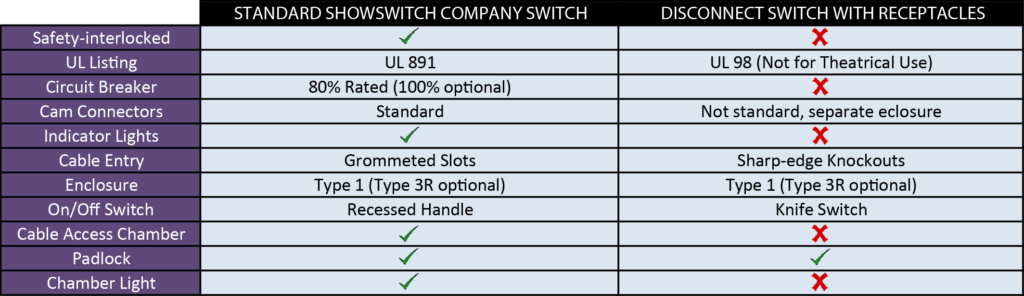
When making purchasing or specifying decisions regarding electrical equipment for entertainment venues there are many factors to consider. The top of the list should always be safety. When it comes to making a decision between company switches and standard disconnect switches, the factor that often takes priority is price. While disconnect switches may often be the more affordable option, the value added into a company switch becomes apparent when features are compared side by side.

Company Switch Chart

The additional safety and features of ESL’s ShowSwitch make it a logical choice for entertainment power needs. The standard safety-interlocked feature of the ShowSwitch prevents live parts from being accessible, thus minimizing electrical hazards. In addition to being safety-interlocked, the ShowSwitch is equipped with an indicator light that clearly shows if the power is on. The ShowSwitch is also designed to be used without a certified electrician once installed. This cuts down significantly on operating costs. Disconnect switches are a generic solution that does not offer the combination of safety features desirable in an entertainment project.

For more information on why choosing a ShowSwitch over a disconnect switch is the right move for you, please contact us at info@eslpwr.com.